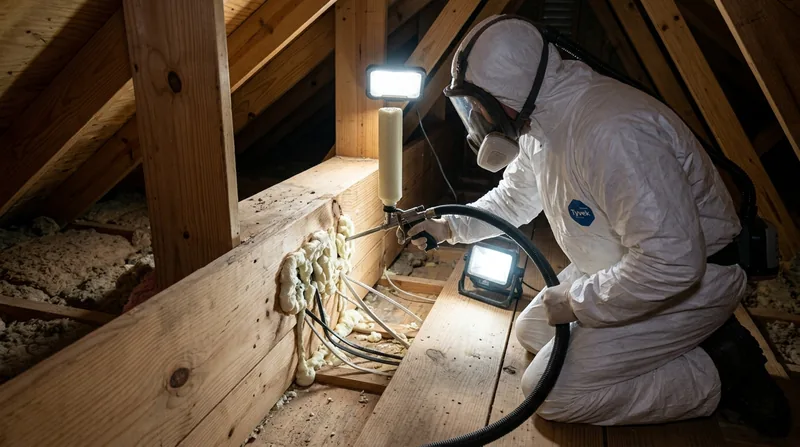




Air sealing in Savannah closes the gaps that let conditioned air escape through your walls, attics, and crawl spaces during the long cooling season. Savannah's mix of century-old frame houses in the Historic District and Ardsley Park, mid-century brick ranches in Midtown, and fast-growing subdivisions toward Pooler and Richmond Hill all share a common problem: air leaks that drive up cooling costs and let humidity creep inward year-round. Hurricane season winds and the Lowcountry's relentless moisture push air through top plates, rim joists, and wall penetrations that fiberglass alone cannot seal. Spray foam air sealing stops that flow, keeping your conditioned air inside and damp coastal air out. We have been sealing Savannah homes since 2010, and we know where the leaks hide in raised crawl spaces, vented attics, and the rim joists that fail first in older stock. A free estimate gets you a concrete plan with R-value and thickness specifications, no sales pressure.
Why Air Sealing Matters in Savannah's Hot, Humid Climate
Savannah sits in climate zone 2A, where the cooling season stretches nine months and humidity drives inward through every gap in your envelope. Vented crawl spaces pull in damp air off the Savannah River, attics in Pooler and Richmond Hill bake through long afternoons, and rooms over garages swing between hot and cold because air escapes through rim joists and top plates. Hurricane season from June through November brings wind-driven rain that tests every air barrier, and year-round moisture means your air conditioning has to work harder just to maintain humidity levels. Fiberglass batts and blown-in cellulose cannot seal air leaks, they only slow conduction. Spray foam fills every gap, stops air movement, and holds moisture out where it belongs.
- We seal top plates where walls meet the attic, stopping warm air from rising and escaping through the roof.
- We close penetrations around plumbing, electrical, and HVAC runs that act as chimneys pulling conditioned air out.
- We seal rim and band joists in raised crawl spaces, the weak point in older Savannah homes where air and moisture enter together.
- We close gaps around attic hatches, exhaust vents, and ductwork that conventional insulation leaves open.
- We air-seal garage walls and ceilings so conditioned air does not escape into unconditioned space.
Each sealed gap means less work for your air conditioning and lower humidity inside your home.
Key info: In Savannah's raised crawl-space homes, rim joists are the first place air and moisture enter. We seal them with closed-cell foam so conditioned air stays inside and the humidity stays out. This single air seal often cuts cooling costs more than adding insulation alone.
For more on how spray foam insulation works in Savannah's specific climate, see our guide to closed cell spray foam insulation.
How We Seal Air Leaks in Savannah Homes and Crawl Spaces
Air sealing starts with finding where air actually moves. We walk the attic, crawl space, garage, and wall cavities to map the leaks, then we seal them with spray foam in the thickness and density that fits the job. Top plates get a bead of closed-cell foam to stop convection. Rim joists get full coverage because they sit at the boundary between conditioned and unconditioned space and take the full load of humidity. Penetrations around plumbing and electrical get foam injected to seal them without drilling into live wiring. We use closed-cell foam for air sealing because it hardens into an air barrier, not just an insulator. Open cell is softer and air can move through it slightly, so we reserve open cell for interior cavities where air movement is not the problem.
- We locate the air leaks using visual inspection and thermal imaging to see where conditioned air is escaping.
- We protect surfaces that should not get foam and set up mechanical ventilation so the space is safe during and after application.
- We apply closed-cell foam at the correct thickness per pass, monitoring drum temperature and the spray gun ratio so the foam cures properly.
- We observe a re-entry window of 24 to 48 hours before the space is fully occupied, allowing off-gassing to complete.
- We provide a written estimate with R-value and thickness specs so you know exactly what you are paying for.
The result is a sealed envelope that holds conditioned air inside through Savannah's long cooling season.
Example: A 1960s brick ranch in Midtown Savannah with a vented attic and an open crawl space had air leaks at the rim joist, the attic hatch, and around the return-air duct in the garage. We sealed the rim joist and hatch with closed-cell foam and injected foam around the duct penetration. The homeowner reported lower humidity in the basement and a noticeably quieter attic during cooling cycles.
Learn more about how air sealing fits into a complete insulation strategy by visiting our attic spray foam insulation page.
Air Sealing Methods and When Each Works Best
| Approach | Description | Best for |
|---|---|---|
| Closed-cell rim joist sealing | Spray closed-cell foam at full thickness on the rim band, blocking air and moisture entry from the crawl space. | Raised crawl-space homes in Savannah, Richmond Hill, and Pooler where humidity and air infiltration dominate. |
| Attic top plate sealing | Apply a bead of closed-cell foam along the top plate where walls meet the attic to stop warm air from rising and escaping through the roof deck. | Vented attics in Midtown and newer subdivisions where cooling loads are high and convection is the main air loss path. |
| Penetration injection foam | Inject foam into wall cavities and around plumbing, electrical, and HVAC penetrations to seal air leaks without full demolition. | Pre-1980 frame houses where walls are solid and retrofit air sealing is needed without opening up the wall. |
| Garage ceiling and wall sealing | Seal the garage ceiling and walls with closed-cell foam so conditioned air from the home does not leak into unconditioned garage space. | Homes in Ardsley Park and newer subdivisions where attached garages create a significant thermal and air boundary. |
Air Sealing Cost in Savannah: What to Expect
Air sealing in Savannah starts at $650 for a focused job like sealing a single attic hatch and top plate or closing rim joist leaks in a small section of a crawl space. Most homes need more comprehensive sealing, which means multiple zones and layers of work. The cost depends on the size of the attic, the length of the rim joist that needs sealing, how many penetrations require foam, and how accessible those areas are. A two-story home in Pooler with a large attic, a full crawl space, and a garage typically runs $1,200 to $2,500 for complete air sealing. A smaller ranch in Thunderbolt or Tybee Island may run $800 to $1,400. Hurricane season and the peak cooling months (June through September) can add a week or two to scheduling, but the work itself is not seasonal.
Get a free written estimate with R-value and thickness specifications so you know what the cost covers. We encourage you to get 2 or 3 estimates and compare not just the price, but what is actually being sealed and the thickness of foam specified. An estimate with no R-value, no thickness, and no breakdown of the zones is a red flag. Visit our pricing page for a full breakdown of what drives cost in different scenarios.
What to Look for When Hiring an Air Sealing Contractor Near Savannah
Air sealing is a trade skill, and the difference between a good job and a poor one shows up six months later when you notice the humidity is still climbing or the smell from the spray has not gone away. A legitimate contractor will give you a written estimate with R-value and thickness, explain whether closed-cell or open-cell foam is right for your job, and be clear about the re-entry window and what to expect during cure. Ask to see proof of insurance and verify it covers the work you are hiring for. Check references from recent jobs in Savannah, Richmond Hill, or your specific neighborhood so you can talk to homeowners who have had the work done. If the contractor promises a price far below market with no on-site inspection, guarantees immediate re-entry, or cannot answer a question about R-value or foam type, that is a sign to call someone else.
Permitting and registration requirements for spray foam work vary by city across Greater Savannah, so ask your local building department what applies at your address. Some jurisdictions require a permit for attic work, others do not. HOA rules in master-planned communities rarely govern insulation, but they may require approval for exterior work on metal buildings or pole barns. Always verify requirements with your city before hiring. Contact us for a free estimate and we will help you understand what permitting, if any, applies to your project. Call (912) 483-1976 or visit our contact page to schedule a walk-through.
Air Sealing in Savannah: Pricing Guide
| Service | Price | Details |
|---|---|---|
| Attic top plate and hatch sealing | Starting at $650 | Seals convection leaks in vented attics, cost depends on attic size and hatch access difficulty |
| Rim joist sealing in crawl spaces | Starting at $800 | Closes air and moisture entry at the foundation, cost scales with linear feet of rim joist and crawl space height |
| Garage ceiling and wall sealing | Starting at $750 | Seals conditioned air leaks into garage space, cost driven by garage size and how many walls need sealing |
| Whole-home air sealing package | Starting at $1,500 | Covers attic, crawl space, rim joists, and garage, most common scope for Savannah homes seeking full envelope closure |
| Penetration injection and retrofit sealing | On estimate | Wall cavity injection and pre-1980 retrofit air sealing require site inspection to assess wall type and access |
| Estimate and travel | Free | Written estimate with R-value and thickness specs, no mileage fee in Savannah and surrounding service areas |
Indicative pricing, the exact cost depends on square footage, finish, and site access. Free personalized estimate within 24h at (912) 483-1976.


