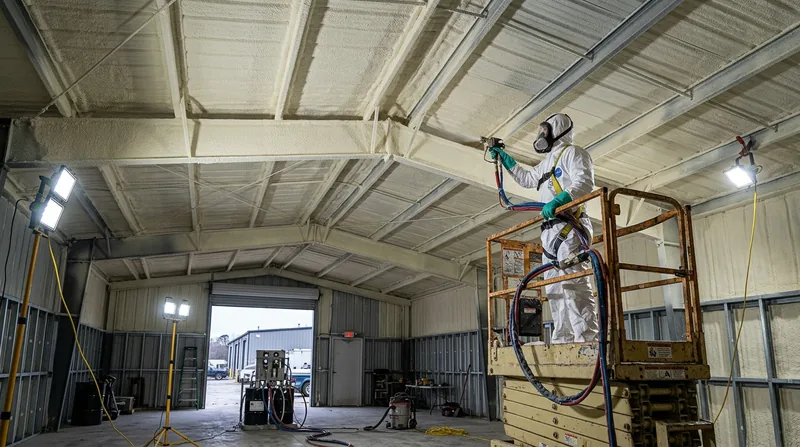




Metal buildings and barndominiums across Savannah, Pooler, and Richmond Hill face a relentless problem: condensation forms on the interior of uninsulated metal panels and purlins, especially during humid coastal summers when warm, moist air meets cold steel overnight. Without a thermal and air barrier, that moisture sweats year-round, rusting fasteners, corroding metal, and creating an uncomfortable, damp interior. Metal building and barndominium spray foam in Savannah stops condensation at the source by sealing foam directly to the steel substrate, blocking both moisture and air infiltration while cutting noise from summer thunderstorms and lowering cooling costs. We spray closed cell foam to metal panels, roof decks, and structural members to create a continuous moisture barrier that protects the building envelope and keeps the interior dry and comfortable. This is not a retrofit luxury; it is the difference between a building that lasts and one that rusts from the inside out.
Why Metal Building Spray Foam Matters in Savannah's Climate
Savannah's Lowcountry heat and humidity create the exact conditions that destroy uninsulated metal buildings. The Savannah River valley pulls moisture inland from the coast, and metal structures without a thermal break sweat constantly from June through September, when outdoor humidity regularly exceeds 80 percent and nighttime temperatures drop into the mid-70s. Vented metal buildings allow that humid air to enter the structure, and when the metal cools, condensation forms on the interior surface. Over months and years, that moisture corrodes fasteners, rusts through seams, and weakens the structural integrity of the building. Metal barndominiums and warehouses across Chatham, Bryan, and Effingham counties face this same risk, especially those built on crawl spaces or over damp ground where ground moisture migrates upward through the foundation.
- Condensation on uninsulated metal panels causes rust, corrosion, and fastener failure over time.
- Closed cell foam creates a continuous vapor barrier that stops moisture before it reaches the steel substrate.
- Spray foam reduces interior noise from rain and hail impact, a significant comfort improvement in hurricane season.
- A foam-sealed metal building holds interior temperature more evenly, reducing HVAC runtime and cooling costs.
- Foam applied to purlins and structural members prevents thermal bridging and cold spots where condensation pools.
These five factors combine to make spray foam the standard solution for metal building condensation control in coastal Georgia.
Key info: A metal barn in Pooler or Richmond Hill without foam insulation will sweat for six to eight months per year. Spray foam applied to the interior roof deck and walls stops that sweating permanently, protecting the steel and the contents inside. See how this compares to our closed cell spray foam insulation service for other building types.
For permitting and code compliance, check with your local building department (Savannah, Pooler, Richmond Hill, or your specific jurisdiction). Metal building insulation may require an ignition barrier or thermal barrier depending on the building use and your local energy code. Your local building department can tell you what applies at your address, but final authority rests with the building official at your permit counter. Learn more about regulations and best practices at the Georgia Construction and Building Inspection Board.
How We Spray Foam Metal Buildings and Barndominiums in Savannah
Metal building spray foam starts with site assessment: we inspect the interior roof deck, purlins, wall panels, and any structural members to identify moisture damage, rust, or areas where condensation is already forming. We check ventilation openings, soffit vents, and ridge vents to see whether the building is vented or sealed. We confirm substrate temperature, humidity, and any existing insulation or coatings that might interfere with foam adhesion. Once we understand the condition and your goals, we prepare the space, set up mechanical ventilation, and spray closed cell foam directly to the metal substrate at the thickness and R-value needed to control condensation and meet code.
- We inspect the metal substrate for rust, moisture damage, and existing coatings before any foam is applied.
- We set up mechanical ventilation to manage fumes during spray and establish a safe re-entry window of 24 to 48 hours.
- We spray closed cell foam at the specified thickness per pass, maintaining proper drum temperature and mix ratio.
- We apply foam to roof decks, purlins, wall panels, and any structural members that bridge the thermal envelope.
- We inspect the cured foam for full coverage, uniform thickness, and proper adhesion to the metal surface.
This step-by-step process ensures the foam bonds securely to the metal, fills all gaps, and delivers the moisture barrier and R-value your building needs.
Example: A metal barndominium in Richmond Hill with a 40-by-60-foot footprint and a sealed metal roof deck typically needs 2 to 3 inches of closed cell foam sprayed to the interior roof and upper wall sections. That thickness delivers an R-value of 12 to 18 and creates a continuous vapor barrier that stops condensation. The job takes one to two days, and the building is ready for light use within 24 hours of completion. See our commercial and new construction spray foam service for larger or complex metal structures.
Spray Foam Methods for Metal Buildings
| Approach | Description | Best for |
|---|---|---|
| Closed Cell Foam to Roof Deck | 2 to 3 inches of closed cell foam sprayed directly to the interior metal roof panels and structural purlins, creating a continuous thermal and moisture barrier. | Metal barndominiums, warehouses, and agricultural buildings where condensation control and structural protection are the primary concern. |
| Closed Cell Foam to Walls and Roof | Full-envelope spray foam applied to interior wall panels and roof deck, sealing the entire building envelope and eliminating thermal bridging at purlins and fasteners. | Converted metal structures, barndominiums with living space, and buildings requiring maximum condensation control and energy efficiency. |
| Rim and Band Joist Foam | Closed cell foam sprayed to the rim joist and band joist where the metal frame meets the foundation, preventing moisture and air infiltration at the base. | Metal buildings on crawl spaces or slab foundations where ground moisture and air leakage are contributing to condensation. |
| Retrofit Over Existing Insulation | Removal of failed or inadequate insulation followed by new closed cell foam spray to restore the thermal and moisture barrier. | Older metal buildings with deteriorated fiberglass or foam, and structures where condensation has returned after previous insulation failed. |
Metal Building and Barndominium Spray Foam Cost in Savannah: What to Expect
Metal building spray foam costs depend on the footprint of the building, the height of the interior space, the thickness of foam required to control condensation and meet code, and the condition of the substrate. A typical metal building or barndominium in Savannah runs from $1.75 per square foot for basic roof-deck foam on a straightforward, accessible structure, up to $3.50 per square foot or more for full-envelope coverage, complex geometry, structural member foam, or substrate preparation. A 40-by-60-foot metal building with a sealed roof deck and 2 inches of closed cell foam might cost $4,200 to $6,300 depending on access, substrate condition, and local labor rates. A larger warehouse or a barndominium with full wall and roof coverage can easily run $8,000 to $15,000 or more.
Factors that affect the final price include the square footage of the building, the thickness of foam needed to stop condensation and meet your code, whether the substrate is clean and dry or requires prep work, the complexity of the roof structure and the number of purlins and fasteners, and the accessibility of the interior space for spray equipment and crew movement. If the metal substrate is rusted or corroded, we assess whether foam adhesion is possible or whether surface preparation is needed first. We never spray foam over wet, contaminated, or heavily rusted substrate; we fix the moisture problem first or we walk away.
The best way to understand the cost for your specific building is to request a free, written estimate. We measure the building on site, discuss your condensation concerns and code requirements, and provide a detailed quote with R-value and thickness specifications. Get your free estimate by calling (912) 483-1976 or visiting our pricing page for more detail on how we calculate costs for metal buildings and other projects.
What to Look for When Hiring a Metal Building Spray Foam Contractor Near Savannah
Metal building spray foam is a specialized trade, and the difference between a competent installation and a failed one shows up in six months to two years when condensation either stops or returns. When you are evaluating spray foam contractors near Savannah, Richmond Hill, Pooler, or anywhere in Greater Savannah, look for these concrete markers of quality and reliability. First, ask for written estimates that include R-value and foam thickness specifications. An estimate with no R-value, no thickness, and no detail is a red flag; it means the contractor has not assessed your building or your code requirements. Second, verify that the contractor carries full insurance and can provide a certificate of insurance on request; call the insurance carrier to confirm coverage is active. Third, ask how the contractor manages fumes during spray and what re-entry window they guarantee; any contractor promising immediate re-entry after spray is cutting corners on ventilation and curing time.
Fourth, get at least two or three estimates from different contractors and compare the specifications, not just the price. A bid that is far below market with no inspection or detail is often a sign of poor quality or a contractor who will not be reachable if problems arise. Fifth, ask for references from recent metal building or barndominium jobs in Savannah or nearby, and call at least two to ask about condensation control, noise reduction, and whether the contractor was responsive after the job was done. Sixth, if your metal building is in a master-planned community or HOA, confirm that any exterior work or roof modifications comply with architectural rules; spray foam to the interior does not usually trigger HOA review, but always check. Finally, verify that the contractor understands local permitting and code requirements for your specific city and building type; permitting and registration vary by jurisdiction across Greater Savannah, and a reputable contractor will defer to your local building official.
Ready to protect your metal building from condensation and rust? Contact us for a free estimate at (912) 483-1976. We are fully insured, we provide written specifications with every quote, and we have been protecting Savannah metal buildings since 2010.
Metal Building & Barndominium Spray Foam in Savannah: Pricing Guide
| Service | Price | Details |
|---|---|---|
| Metal Roof Deck Foam (2 to 3 inches) | Starting at $1.75/sq ft | Closed cell foam sprayed to interior roof panels and purlins, includes site assessment and mechanical ventilation during cure |
| Full Envelope Coverage (Roof and Walls) | Starting at $2.50/sq ft | Closed cell foam applied to entire interior, roof deck, wall panels, and structural members for maximum condensation and thermal control |
| Substrate Prep or Rust Remediation | On estimate | Required when metal substrate is corroded, wet, or contaminated; assessed on site before foam application begins |
| Insulation Removal and Replacement | On estimate | Removal of failed or inadequate insulation followed by new closed cell foam; cost depends on existing material volume and disposal |
| Travel and Estimate | Free | No charge for site visit or written estimate; response within 24 hours at (912) 483-1976 across Savannah service area |
Indicative pricing, the exact cost depends on square footage, finish, and site access. Free personalized estimate within 24h at (912) 483-1976.


