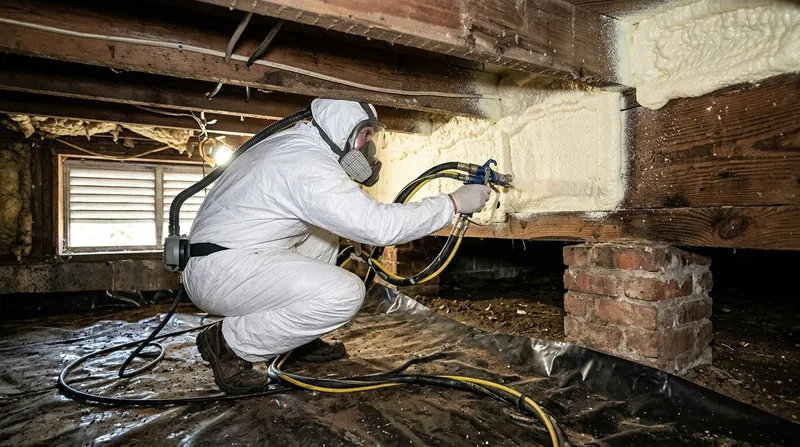




Closed cell spray foam insulation in Savannah addresses the core moisture challenge of the Lowcountry: hot, humid air pressing inward through walls and foundations from June through November, and coastal moisture working into rim joists, band joists, and crawl space walls year-round. Unlike open cell foam or fiberglass batts, closed cell foam creates a rigid, moisture-blocking barrier that stops water vapor and air infiltration at once. In historic Ardsley Park homes with raised crawl spaces, modern subdivisions in Pooler and Richmond Hill with slab foundations, and older frame houses throughout Chatham County, closed cell spray foam seals the gaps that vented attics and rim joists cannot control. Savannah's mix of century-old wood frame construction and newer stick-built homes over crawl spaces means the weak points are predictable: rim joists under first-floor rooms, band joists where the house sits on the foundation wall, and the rim cavities in older homes that pull in damp air every summer. We build up closed cell foam in measured passes to the right thickness, creating an air barrier and vapor retarder in one application. For crawl spaces, rim joists, and sealed roof decks, closed cell is the technical answer to Savannah's humidity.
Why Closed Cell Spray Foam Matters for Savannah's Humid Crawl Spaces and Rim Joists
Savannah's housing stock sits on two foundations: raised crawl spaces with vented walls in historic neighborhoods and older suburbs, and slab-on-grade in newer construction. Both pull humid air inward. Vented crawl spaces in Ardsley Park, Midtown, and older areas of Pooler and Richmond Hill are designed to let air flow through, but that air is saturated with moisture off the Savannah River and the Atlantic. Rim joists, where the band board meets the foundation wall, are the first condensation point: warm interior air meets cold foundation concrete, and moisture condenses onto wood framing. Closed cell spray foam stops that exchange. It is rigid, it blocks moisture vapor, and it does not absorb water the way fiberglass or open cell foam does.
- We apply closed cell foam in controlled passes to build up the correct R-value and thickness for rim joists, typically 1.5 to 2 inches, without overspray or voids.
- The foam cures to a solid, non-settling barrier that does not sag or compress under the weight of rim cavity insulation or thermal cycling.
- Closed cell blocks both air infiltration and water vapor, protecting wood framing from rot and mold in Savannah's humid climate.
- We do not spray over wet substrates; if a rim joist shows active moisture or a crawl space has standing water, we walk away until the moisture is fixed first.
Closed cell foam in rim joists and crawl space walls is the difference between a rim cavity that stays dry and one that becomes a condensation trap by August.
Key info: A 1950s frame house in Ardsley Park with a vented crawl space and exposed rim joists typically shows condensation stains and soft wood by year five. Closed cell spray foam at 1.5 inches on the rim joist and band wall, paired with air sealing of rim cavity gaps, stops the problem cold. We write the R-value and thickness into the estimate so you know exactly what you are getting.
How We Install Closed Cell Spray Foam in Savannah Homes and Crawl Spaces
Closed cell spray foam installation is a measured, multi-pass process. We do not spray the entire thickness in one pass; that creates voids, uneven density, and poor adhesion. Instead, we build up the foam in layers, checking density and coverage between each pass. For rim joists, we typically spray 1.5 to 2 inches in two or three passes. For crawl space walls, we may go 2 to 3 inches depending on the R-value target and the substrate. Each pass means the previous layer has set enough to hold the next without slumping. We use mechanical ventilation during and after application to manage odor and cure time, and we establish a clear re-entry window of 24 to 48 hours before the space is safe for occupancy. The process is not quick, and it is not cheap, but it is right.
- We inspect the substrate for moisture, rot, or active leaks before we set up; if the rim joist or crawl space wall is wet, we do not spray.
- We set up containment and mechanical ventilation before we mix the first drum of foam.
- We spray the first pass, allow it to cure, then apply the second and third passes to reach the specified thickness and R-value.
- We use air sealing around the foam edges and at rim cavity gaps to complete the thermal and moisture barrier.
- We provide a written estimate with the R-value, thickness in inches, and board-foot count before we start.
The result is a rigid, moisture-proof barrier that stays in place and performs for decades.
Example: A Richmond Hill home with a new addition over a crawl space needed the rim joist insulated to code. We sprayed 1.5 inches of closed cell foam on the rim joist and band wall, sealed the rim cavity gaps, and mechanically ventilated for 48 hours. The homeowner was back in the space in three days, and the rim joist stayed dry through the next two humid summers.
Closed Cell Spray Foam Methods and Applications in Savannah
| Approach | Description | Best for |
|---|---|---|
| Rim Joist Spray | 1.5 to 2 inches of closed cell foam applied in two to three passes on the rim joist and band wall, with air sealing of rim cavity gaps. | Historic Savannah homes and older Pooler subdivisions with vented crawl spaces and exposed rim joists. |
| Crawl Space Wall Insulation | 2 to 3 inches of closed cell foam on foundation walls and rim joists to create a vapor barrier and thermal break. | Vented crawl spaces pulling in humid air, especially in Ardsley Park, Midtown, and older Chatham County neighborhoods. |
| Sealed Attic Rim and Soffit | Closed cell foam on rim joists at the attic perimeter and soffit edges to stop air leakage and condensation in sealed, unvented attics. | New construction and retrofit sealed attics where the attic is part of the conditioned envelope. |
| Metal Building and Garage Walls | 2 to 4 inches of closed cell foam on the interior of metal building walls and garage rim joists to prevent condensation on steel. | Metal buildings, barndominiums, and garage additions in Pooler, Richmond Hill, and Bloomingdale where condensation control is critical. |
| Retrofit Wall Injection | Closed cell foam injected into existing wall cavities of pre-1980 frame homes without removing siding or drywall. | Century-old Ardsley Park and Historic District homes where cavity walls are empty and moisture is a concern. |
Closed Cell Spray Foam Insulation Cost in Savannah: What to Expect
Closed cell spray foam costs more per board foot than open cell foam or fiberglass, but it delivers moisture control and rigidity that neither alternative provides. In Savannah, closed cell foam typically starts at $1.20 per board foot and can range up to $1.60 or higher depending on the job scope, substrate condition, and access. A rim joist project on a 2,000-square-foot home might run 100 to 150 board feet, putting the material cost in the $120 to $240 range; labor, equipment, and ventilation setup add significantly to that. A crawl space wall insulation project is larger, often 300 to 600 board feet, and costs scale accordingly. The biggest variables are access (tight crawl spaces cost more to work in), substrate prep (if the rim joist or wall has to be cleaned or dried first, that adds time), and the R-value target (thicker foam means more board feet and more passes). We do not quote a firm price until we see the job on site, measure the square footage, and understand what the substrate looks like. A free written estimate from Savannah Spray Foam Insulation includes the R-value, thickness, board-foot count, and labor, so you know exactly what the cost covers and why.
Getting two or three estimates from different contractors is the smartest move. Look for estimates that name the R-value, the thickness in inches, and the board-foot total. If an estimate has no R-value or thickness, it is not a real estimate. Check that the contractor is fully insured and that you can verify the insurance on request. Ask about the cure time and re-entry window; if a contractor promises immediate re-entry, that is a red flag. The cheapest estimate is rarely the best deal; the best deal is the one where the contractor explains what you are getting, shows their work, and is reachable if questions come up after the job is done. For detailed pricing guidance and to discuss your specific project, visit our pricing page or call us at (912) 483-1976.
What to Look for When Hiring a Closed Cell Spray Foam Insulation Contractor Near Savannah
Hiring the right spray foam contractor is the difference between a job that works for thirty years and one that creates problems. The spray foam trade has two extremes: rig-and-run crews that show up in an out-of-state trailer, spray a job in an afternoon, and are unreachable when the smell lingers or the foam settles; and national franchises that may have deep pockets but little local knowledge of Savannah's crawl spaces, humidity, and building codes. The local independent contractor, if you vet them correctly, offers accountability and expertise. Start by verifying that the contractor is fully insured; ask for proof of general liability and workers' compensation insurance, and verify the policy is active. Ask for references from jobs done in the last year in Savannah or nearby areas, and call at least two of them. Get written estimates from two or three contractors, and compare the R-value, thickness, and board-foot count. If the estimates are wildly different in price but the specs are the same, ask why. Understand that Savannah's building codes, HOA rules, and permit requirements vary by neighborhood and city. A contractor working in Ardsley Park or the Historic District may face different ventilation and thermal barrier rules than one working in Pooler or Richmond Hill. Ask your contractor to confirm what applies at your address; if they do not know, they should defer to the local building department, not guess. For a free estimate and to discuss your project in detail, call (912) 483-1976 or request an estimate online. We are fully insured, we provide written estimates with R-value and thickness specs, and we are local and reachable if you have questions after the job is done.
Closed Cell Spray Foam Insulation in Savannah: Pricing Guide
| Service | Price | Details |
|---|---|---|
| Rim Joist Insulation | Starting at $1.20/board ft | 1.5 to 2 inches of closed cell foam on rim joists and band walls; access and substrate condition affect final cost |
| Crawl Space Wall Insulation | Starting at $1.25/board ft | 2 to 3 inches of closed cell foam on foundation walls; larger square footage and moisture prep work shift cost upward |
| Metal Building or Garage Walls | Starting at $1.35/board ft | 2 to 4 inches closed cell on steel surfaces to prevent condensation; thicker applications and tight spaces increase per-board-foot cost |
| Retrofit Wall Injection | Starting at $1.40/board ft | Closed cell injected into existing cavities of pre-1980 homes; drilling, cavity prep, and cavity depth determine final pricing |
| Travel and Setup | Included | No separate mileage or travel fee for Savannah and surrounding service areas within Chatham, Bryan, and Effingham counties |
| Free Written Estimate | No charge | Response within 24 hours at (912) 483-1976; includes R-value, thickness, board-foot count, and labor estimate |
Indicative pricing, the exact cost depends on square footage, finish, and site access. Free personalized estimate within 24h at (912) 483-1976.


