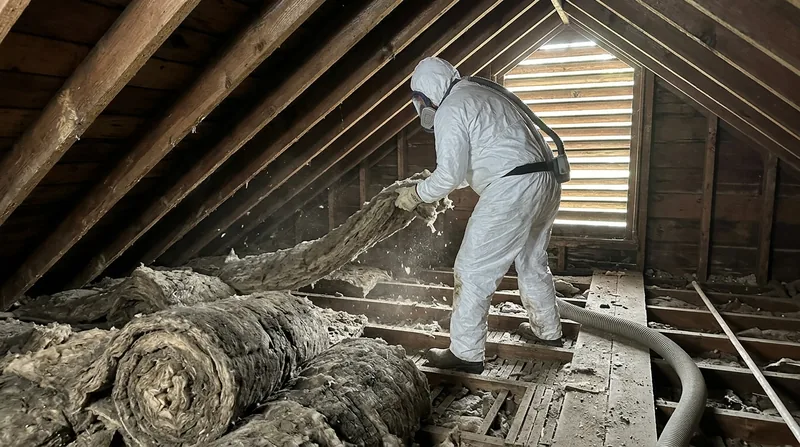




Old insulation in Savannah attics and crawl spaces traps decades of coastal moisture, musty odors, and degraded fibers that no amount of air sealing can fix. Insulation removal in Savannah is the foundation of every retrofit, especially in the century-old frame houses of Ardsley Park and the mid-century brick ranches across Midtown where vented attics and raised crawl spaces pull in damp air off the Savannah River throughout the year. Whether you're dealing with settled fiberglass that has lost its R-value, old blown-in cellulose packed with moisture, or failed spray foam from a previous contractor, we remove it cleanly and completely so new foam can go in on a dry, sound substrate. The Lowcountry's hot, humid climate means moisture drives inward most of the year, and removing contaminated insulation is not optional if you want the new system to work. We serve Savannah, Pooler, Richmond Hill, and the surrounding counties with the equipment and expertise to handle attics, walls, crawl spaces, and rim joists without leaving dust, debris, or odors behind.
Why Insulation Removal Matters in Savannah's Humid Climate
Savannah's moisture problem is year-round. Coastal air, high humidity, and the pattern of vented attics and crawl spaces mean that old insulation absorbs water, compacts, loses R-value, and begins to smell. Fiberglass settles and becomes ineffective. Cellulose absorbs moisture like a sponge. Failed spray foam from a rushed or low-quality installation traps water and becomes a liability rather than an asset. Removing contaminated insulation before installing new foam is not a luxury, it is the only way to ensure the new system performs and lasts.
- Old fiberglass and cellulose in Savannah attics absorb moisture and lose R-value, making them nearly useless after 15 to 20 years.
- Vented crawl spaces pull in damp coastal air that saturates existing insulation, creating musty odors and conditions for mold growth.
- Failed spray foam installations from out-of-state contractors often lack proper thickness, ventilation during cure, or thermal barriers, and must be removed before new work begins.
- Removing old insulation also reveals roof leaks, condensation damage, or pest entry points that must be addressed before new foam goes in.
- A clean substrate and proper removal process are the prerequisites for any warranty-backed insulation retrofit.
Without removal, new insulation installed over old, wet, or contaminated material will fail just as quickly as what came before.
Key insight: In Savannah and Richmond Hill, where many homes sit on raised crawl spaces with vented rim joists, old fiberglass or cellulose insulation in those rim cavities is often the first place moisture accumulates and R-value disappears. Removal and replacement with closed cell spray foam is one of the highest-ROI upgrades in the region.
For more on what happens after removal, see our guide to closed cell spray foam insulation, the most common choice for retrofit work in humid climates.
Georgia law requires that any contractor working on a property verify utility locations before excavation. While insulation removal rarely involves digging, we comply with all local building codes and work with your building department to confirm what permits or notifications apply at your address. Check the City of Savannah Building Permits page for specifics on your location.
How We Remove Insulation: Our Process for Savannah Attics, Walls, and Crawl Spaces
Insulation removal is a methodical job that requires containment, ventilation, and careful disposal. We do not rush it. Our crew arrives with the right equipment to isolate the work area, extract old material without spreading dust or fibers throughout your home, and haul it away to a licensed facility. We assess the substrate for damage, moisture, or contamination, and we flag any issues before the retrofit begins. The result is a clean, dry, ready surface for new spray foam.
- We set up containment barriers to prevent dust and fibers from spreading into occupied spaces and HVAC ducts.
- We use mechanical ventilation and HEPA-filtered vacuum systems to capture and remove old insulation safely and completely.
- We inspect the substrate (roof deck, framing, rim joists, walls) for moisture damage, rot, pest entry, or roof leaks that must be fixed before new foam is installed.
- We haul all removed material to a licensed disposal facility and provide documentation of proper disposal.
- We leave the space clean, dry, and ready for the next phase of your insulation retrofit.
This discipline is what separates a professional removal from a rig-and-run crew that bags material and leaves the mess for you to sort out later.
Example: A homeowner in Garden City called us after a previous contractor had sprayed open cell foam over wet, moldy fiberglass in an attic. We removed the foam and the compromised insulation, dried the substrate with mechanical ventilation, addressed a roof leak the previous contractor had missed, and then installed closed cell foam with proper ventilation and a thermal barrier. The job took three days instead of one afternoon, but the result was a durable, code-compliant system that works.
Learn more about what comes next by visiting our attic spray foam insulation page, or call us at (912) 483-1976 for a free estimate on your specific removal and retrofit needs.
Insulation Removal Methods for Different Spaces
| Space Type | Method | Why It Matters |
|---|---|---|
| Attics (fiberglass, cellulose, failed foam) | Mechanical extraction with HEPA vacuum and containment barriers. | Prevents dust and fibers from entering living spaces and HVAC systems; allows full inspection of roof deck and framing. |
| Crawl spaces (settled fiberglass, wet cellulose) | Controlled removal with portable ventilation and moisture monitoring. | Crawl spaces are tight and damp; removal must account for moisture and air quality during work and cure. |
| Walls and rim joists (old fiberglass, injection foam) | Selective demolition with local ventilation; injection foam requires careful extraction to avoid wall damage. | Walls are structural; removal must preserve framing and vapor barriers while exposing cavities for new foam. |
| Garages and metal buildings (old foam, fiberglass) | High-volume extraction with mobile equipment and site-specific ventilation planning. | Metal buildings and garages are often large, uninsulated spaces; removal must manage dust and VOCs without affecting adjacent occupied spaces. |
Insulation Removal Cost in Savannah: What to Expect
Insulation removal pricing in Savannah starts at $950 for a small attic or crawl space section, and scales with the square footage, material type, and complexity of the space. The cost depends on how much material is there, how difficult it is to access, whether the substrate is wet or contaminated, and whether the job requires special handling or disposal. We provide written estimates with R-value and thickness specifications so you know exactly what you are paying for and what the retrofit will look like when it is done.
A typical attic removal in a Savannah ranch or colonial-style home runs between $1,200 and $2,500, depending on attic size and insulation depth. Crawl space removal is often higher because of access challenges and moisture control. Wall or rim joist removal is smaller in scope but requires precision to avoid structural damage. The best way to know your cost is to call us at (912) 483-1976 for a free, no-obligation estimate. We inspect the space, identify the material and its condition, and give you a firm number before any work begins.
Do not accept an estimate without R-value and thickness specifications, or one that does not account for substrate inspection and proper disposal. Low-ball pricing often signals a crew that will cut corners on containment, ventilation, or documentation, and you will pay for it later when odors linger or new insulation fails. Visit our full pricing overview for detailed breakdowns and to understand what drives costs up or down on your specific job.
What to Look for When Hiring an Insulation Removal Contractor Near Savannah
Finding the right contractor for insulation removal near Savannah means checking credentials, getting multiple estimates, and understanding what you are paying for. Do not hire based on price alone. A professional removal contractor should provide a written estimate with material type, square footage, and disposal method clearly stated. They should explain the inspection process and what happens if the substrate is wet or damaged. They should carry full insurance and be reachable after the job is done if questions arise. If a contractor promises immediate re-entry or guarantees no smell, they are cutting corners on ventilation and cure time.
- Verify that the contractor is fully insured and can provide a current certificate of insurance before work begins.
- Ask for references from at least two Savannah-area jobs and follow up with those homeowners about their experience and the quality of the removal.
- Get written estimates from at least two contractors so you can compare scope, material handling, and disposal methods side by side.
- Confirm that the contractor understands local building codes and permits, and will work with your city or county building department if required.
- Ask about the re-entry window after new foam is installed and what mechanical ventilation or off-gassing time is planned.
- Check that the contractor inspects the substrate and flags any moisture, damage, or pest entry before quoting the retrofit.
The strongest signal of a professional contractor is one who says no to a wet substrate, who explains why ventilation matters during cure, and who provides documentation of proper disposal and insurance coverage.
Ready to move forward? Contact us for a free estimate, or call (912) 483-1976 to discuss your removal and retrofit project.
Insulation Removal in Savannah: Pricing Guide
| Service | Price | Details |
|---|---|---|
| Small attic or crawl space section | Starting at $950 | Partial removal, up to 500 sq ft, includes substrate inspection and proper disposal |
| Full attic removal (typical Savannah home) | Starting at $1,200 | 1,000 to 1,500 sq ft attic, all material removed, substrate inspected, hauled and disposed |
| Crawl space or rim joist removal | Starting at $1,400 | Access challenges and moisture control; cost varies by space size, material type, and contamination |
| Wall or injection foam removal | On estimate | Requires on-site inspection to assess wall integrity, cavity access, and material condition before pricing |
| Large commercial or metal building removal | On estimate | High-volume spaces need site-specific ventilation and disposal planning; quote depends on square footage and material |
| Free estimate and inspection | No charge | We inspect the space, identify material type and condition, and provide written estimate within 24 hours |
Indicative pricing, the exact cost depends on square footage, finish, and site access. Free personalized estimate within 24h at (912) 483-1976.


