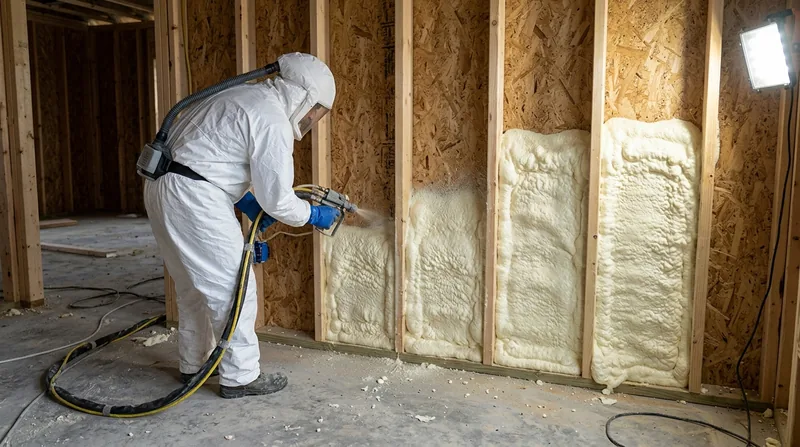




Open cell spray foam insulation in Savannah fills stud cavities in new subdivision walls and quiets rooms over garages where sound dampening and mild-winter comfort matter more than vapor control. In Savannah's hot, humid climate, open cell foam works best in interior walls and ceiling applications where the air-conditioning system already manages moisture. Older frame homes in Ardsley Park and mid-century ranches in Midtown benefit from open cell in finished rooms, while newer construction in Pooler and Richmond Hill often pairs open cell with proper ventilation to handle the long cooling season. Unlike closed cell foam, open cell is lower-cost per board foot and breathes, making it the right choice when vapor permeability is acceptable or even desirable. We spray open cell walls and ceilings across Chatham, Bryan and Effingham counties, and we'll tell you plainly when a simpler option like blown-in fiberglass is the better answer.
Why Open Cell Spray Foam Matters in Savannah's Hot, Humid Climate
Savannah's cooling season runs long, and rooms over garages or at the top of two-story homes in subdivisions from Pooler to Richmond Hill bake through the summer. Open cell foam fills cavities completely, stops air leakage, and reduces the load on your air conditioning. In climate zone 2A, where moisture drives inward most of the year, open cell's breathability allows walls to dry toward the interior during mild winters and prevents vapor traps that closed cell can create in certain retrofit scenarios. Sound control is a bonus: open cell's open structure absorbs noise between rooms and from outdoor traffic better than fiberglass or blown-in cellulose.
- Open cell spray foam reduces air leakage through stud cavities in new walls and retrofit ceiling applications across Savannah.
- The foam's lower density allows it to absorb sound frequencies that bother homeowners in rooms over garages or near busy streets.
- Open cell costs less per board foot than closed cell, making it the budget-conscious choice for interior walls where vapor control is not the limiting factor.
- In Savannah's humid climate, open cell's breathability prevents moisture buildup in walls where vapor barriers would trap condensation.
- Typical R-value is R-3.5 to R-3.7 per inch, requiring 5 to 6 inches of thickness to reach R-20 in a 2x6 wall cavity.
For homeowners deciding between open cell and closed cell, the choice hinges on use: closed cell is the answer for crawl spaces, rim joists, and metal buildings where vapor control and structural strength matter. Open cell is the answer for interior walls, finished ceilings, and sound-dampening applications in Savannah's subdivisions and mid-century homes.
Key info: A room over a garage in a Richmond Hill subdivision loses conditioning through the floor cavity. Open cell foam in the ceiling cavity above the garage reduces that heat transfer and quiets the space. The foam is sprayed to fill the entire cavity, then trimmed flush with the framing for drywall installation.
How We Spray Open Cell Foam in Savannah Walls and Ceilings
Open cell spray foam starts with a site inspection to identify the cavities, confirm substrate conditions, and check for any moisture or contamination that would stop the job. We confirm that framing is dry and that any existing insulation or debris is removed. The spray rig is positioned for access to all cavities, and we set up mechanical ventilation to manage off-gassing during cure. Once the substrate is cleared and ventilation is running, we spray the foam in passes, building thickness and density according to the manufacturer's ratio and drum temperature.
- We inspect the cavity, measure depth and width, and confirm the substrate is dry and free of contamination before any spray begins.
- Mechanical ventilation is set up and running before the first pass to manage isocyanate vapor and ensure worker safety during application.
- We spray the foam in controlled passes, allowing each layer to rise and cure before the next pass, building to the specified thickness and density.
- Once the foam reaches full height and density, we trim it flush with the framing using a hot wire or handsaw for drywall or paneling installation.
- The home is ventilated for 24 to 48 hours before occupancy, and we confirm the cure window with the homeowner in writing.
The entire process typically takes one day for a single-room application or a finished attic in a Savannah home. Larger projects, such as a full second story or multiple rooms, may require two days. See our attic spray foam insulation page for sealed-roof and vented-attic applications.
Example: A new construction home in a Pooler subdivision has 2x6 exterior walls with 16-inch on-center framing. We spray open cell to 5.5 inches, achieving R-19 in the cavity. The foam is trimmed flush, and the builder installs vapor barrier and drywall the next day. Re-entry is 24 hours after spray completion.
Open Cell Spray Foam Application Methods and Best Uses
| Approach | Description | Best for |
|---|---|---|
| Stud Cavity Fill | Spray open cell to fill 2x4 or 2x6 wall cavities from bottom plate to top plate, achieving full R-value in the cavity. | New construction walls, interior partition walls, retrofit walls in Savannah homes where thermal and sound performance are priorities. |
| Ceiling and Attic Cavities | Spray open cell into joist cavities or over attic floor framing to create an air barrier and insulation layer in finished spaces. | Finished attics, rooms over garages, second-story ceilings in Pooler and Richmond Hill homes where sound control and conditioning matter. |
| Sound Dampening Retrofit | Spray open cell into existing wall cavities from the interior (after removing drywall) or into ceiling cavities to absorb noise between rooms and floors. | Mid-century ranches in Midtown Savannah with thin walls, homes near traffic, rooms above garages where sound isolation is the driver. |
| New Construction Framing | Spray open cell into walls and ceilings during framing phase, before electrical, plumbing and HVAC rough-in, for complete cavity fill and air sealing. | Subdivisions in Pooler, Richmond Hill, Garden City where builders specify open cell for cost and performance balance in production homes. |
Open cell foam is not the answer for crawl spaces, rim joists, or metal buildings in Savannah. For those applications, closed cell spray foam insulation is the standard because vapor control and structural rigidity are non-negotiable. If your home has a vented crawl space or exposed band joist, closed cell is the right choice.
Open Cell Spray Foam Insulation Cost in Savannah: What to Expect
Open cell spray foam in Savannah typically costs from $0.55 to $0.70 per board foot, depending on access, cavity depth, and whether existing insulation must be removed first. A typical stud cavity application in a new subdivision or retrofit ceiling runs 200 to 400 board feet, translating to $110 to $280 in material and labor before any removal or site prep. Larger projects, such as a full second story or multiple rooms, scale the cost but often bring the per-board-foot rate down because setup and mobilization are shared across more square footage.
The main cost drivers are straightforward: deeper cavities (2x8 or 2x10 rim joists) require more foam; difficult access (attics with low headroom, crawl spaces, or tight framing) slows the spray and raises labor time; and removal of existing insulation or contaminated material adds a separate line item. Savannah's humid climate means we sometimes encounter mold or moisture conditions that require the cavity to be dried or cleaned before foam can be sprayed, and that precondition work is priced separately.
The only way to get an accurate number is a site visit and a written estimate with R-value and thickness specs. We provide free estimates within 24 hours across Savannah, Pooler, Richmond Hill and surrounding areas. Call (912) 483-1976 or visit our pricing page for typical ranges and project examples.
What to Look for When Hiring an Open Cell Spray Foam Contractor Near Savannah
Choosing the right spray foam installer is as important as the product itself. A bad installation, with poor ratio, low thickness, or skipped ventilation, creates off-gassing problems and leaves you with a callback that costs more than the original job. The local independent contractor with a Savannah address and verifiable insurance is your safest bet against the rig-and-run crews and the national franchises that leave you stranded when the smell won't go away.
Start by asking for a written estimate that names the R-value per inch, the total thickness, and the number of board feet. If an estimate has no R-value or thickness, walk away. Confirm that the contractor carries general liability insurance and can provide a certificate of insurance naming you as additional insured. Ask for references from jobs in Savannah or nearby cities completed in the last two years, and call at least two of them. Check whether the contractor has a physical address and phone number in the area, and verify that they answer the phone or return calls within 24 hours.
For new construction, confirm that the builder or general contractor has reviewed the spray foam specification and that permits, if required by your city, are pulled before work begins. For retrofit work in older homes, ask whether any existing insulation removal is included and whether the contractor will inspect for moisture or contamination before spraying. Savannah's humidity means moisture is a real issue, and an honest contractor will say so upfront.
- Request a written estimate with R-value per inch, total thickness in inches, and total board feet, never a price with no specs.
- Confirm that the contractor carries general liability insurance and provides a certificate of insurance on request.
- Ask for at least two references from completed jobs in Savannah or nearby areas, and call them to ask about quality and responsiveness.
- Verify that the contractor has a local address and phone number, and that they answer calls or return messages within 24 hours.
- For retrofit work, ask whether existing insulation removal and moisture inspection are included or priced separately.
- Confirm that the contractor will provide a written re-entry window of 24 to 48 hours and will run mechanical ventilation during cure.
Contact us at our contact page to request a free, no-obligation estimate. We've been serving Savannah and surrounding areas since 2010, and we're fully insured. We'll give you a written estimate with R-value and thickness specs, and we'll tell you plainly if a cheaper option is the right answer for your home.
Open Cell Spray Foam Insulation in Savannah: Pricing Guide
| Service | Price | Details |
|---|---|---|
| Open Cell Stud Cavity Fill | Starting at $0.55/board ft | 2x4 or 2x6 wall cavities, complete fill to specified thickness, trimmed flush for drywall installation |
| Open Cell Ceiling and Attic | Starting at $0.60/board ft | Finished attics, rooms over garages, joist cavities, sound dampening; access and existing insulation removal affect final price |
| Retrofit Wall Cavity (Interior Access) | Starting at $0.65/board ft | Existing wall cavities sprayed from interior after drywall removal, includes drywall patching and finishing labor |
| Existing Insulation Removal | From $0.15/board ft | Blown-in fiberglass or cellulose removal before spray foam application, disposal included, priced separately |
| Travel | Included | No mileage or trip charge in Savannah, Pooler, Richmond Hill, Garden City, Port Wentworth and surrounding Chatham and Bryan counties |
| Free Estimate | No charge | Written estimate with R-value, thickness and board feet, response within 24 hours, (912) 483-1976 |
Indicative pricing, the exact cost depends on square footage, finish, and site access. Free personalized estimate within 24h at (912) 483-1976.


