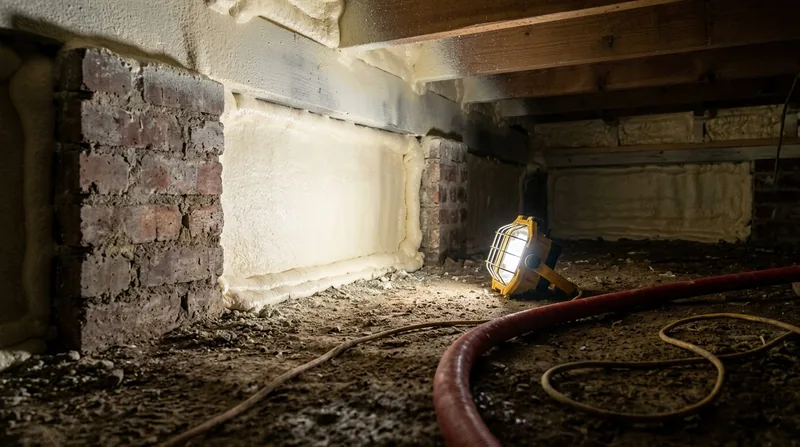




Savannah's raised crawl spaces under century-old frame houses in Ardsley Park, Pooler, and Richmond Hill pull in damp coastal air year-round, turning foundations into moisture traps that breed musty odors, rotting wood, and damp ductwork. Crawl Space Spray Foam Insulation in Savannah seals these vented foundation walls with closed-cell foam, stops the humid air at the source, and keeps the space below your home dry and conditioned. In climate zone 2A, where cooling runs nine months a year and the Lowcountry's water table sits high, a sealed and insulated crawl space cuts energy loss through the foundation and eliminates the musty basement smell that plagues older homes across Greater Savannah. We spray foam the walls, band joists, and rim joists to stop air and moisture infiltration, then help you decide whether to encapsulate the floor or leave it vented based on your home's condition and your budget. This is the work that pays for itself in comfort and lower bills, and it is the foundation of every energy retrofit we do.
Why Crawl Space Insulation Matters in Savannah's Humid Climate
Vented crawl spaces were standard in Savannah's older housing stock because builders assumed the ventilation would dry them out. That assumption fails in the Lowcountry. Our summers are hot and humid, and the air outside is often warmer and wetter than the air under your house. When outside air flows through foundation vents, it brings moisture with it. That moisture condenses on ductwork, soaks into rim joists, and creates the perfect environment for wood rot and mold. Spray foam stops this cycle cold by sealing the walls and creating a thermal and moisture barrier that keeps damp coastal air out and conditioned air in.
- Sealed foam walls block humid air from entering through foundation vents and cracks.
- Ductwork stays dry and efficient, cutting HVAC losses that waste cooling energy all summer.
- Wood rim joists and band joists no longer absorb moisture and rot from below.
- Musty odors disappear because the space no longer pulls in damp coastal air.
- Basement and first-floor rooms run warmer in winter and cooler in summer because the foundation is no longer a thermal sieve.
Every one of these benefits compounds over the life of your home, and the payoff is strongest in Savannah's high-humidity climate where moisture drives inward for nine months out of the year.
Key info: Savannah's raised crawl spaces sit only 18 to 36 inches above grade in most older neighborhoods. That proximity to the water table means moisture pressure is constant. Sealed foam stops it at the wall, not at the duct or the rim joist. In Pooler and Richmond Hill subdivisions, newer construction often sits on slabs, but the older stock around Ardsley Park and Midtown Savannah relies on vented crawl spaces, making them the single biggest thermal and moisture weak point in pre-1980 homes.
For more on how moisture affects your home's foundation, consult Chatham County Stormwater Services, which publishes guidance on foundation drainage and crawl space moisture in the Savannah area.
How We Seal and Insulate Your Crawl Space: Step by Step
Our process starts with a walk-through to assess the crawl space condition, ductwork layout, and moisture level. If we find standing water, active leaks, or saturated soil, we stop and refer you to a foundation or drainage specialist. We do not spray foam over wet substrates. If the space is dry or drying, we proceed with foam and air sealing. Closed-cell foam is the standard for crawl spaces because it resists moisture, adds R-value per inch (typically R-6 per inch), and creates a true vapor barrier. We spray the foundation walls from the rim joist down to the sill plate, then seal band joists and any rim joist gaps to stop air infiltration. The result is a conditioned, dry crawl space that breathes less and costs less to heat and cool.
- We inspect the crawl space for moisture, mold, active leaks, and structural damage before any foam is applied.
- We set up mechanical ventilation and establish a re-entry window of 24 to 48 hours after spraying is complete.
- We apply closed-cell foam to foundation walls, typically 3.5 to 5.5 inches thick, to achieve R-20 to R-33 depending on your goal.
- We seal band joists, rim joists, and all air leaks around ductwork, plumbing, and electrical penetrations.
- We inspect the final result for coverage, thickness consistency, and any missed seams before we leave the job.
The entire process typically takes one to three days depending on crawl space size and complexity. Our crew works during business hours, and your home is safe to occupy after the re-entry window has passed.
Local example: A 1,400-square-foot Ardsley Park cottage with a 1,200-square-foot crawl space, vented rim joists, and damp ductwork took two days to fully seal and foam. Closed-cell spray at 4 inches R-24 stopped the moisture infiltration, dried the ductwork within a week, and cut the homeowner's cooling costs by an estimated 12 to 18 percent. The musty smell was gone in 48 hours.
Learn more about how we approach closed-cell spray foam insulation in Savannah, which is the workhorse for crawl space sealing.
Crawl Space Spray Foam Insulation Methods and Approaches
| Approach | Description | Best for |
|---|---|---|
| Closed-Cell Wall Spray | 3.5 to 5.5 inches of closed-cell foam applied directly to foundation walls from rim joist to sill, creating a vapor barrier and R-20 to R-33 insulation in one pass. | Vented crawl spaces with moisture infiltration, damp ductwork, or rot risk in older Savannah homes. |
| Band and Rim Joist Sealing | Spray foam applied to the rim joist band, sill plate, and all air leaks around the perimeter where the house frame meets the foundation, stopping air infiltration at the thermal boundary. | Complementary to wall spray; often the first step in older homes where rim joists are the worst thermal leak. |
| Partial Encapsulation | Foam walls plus sealed floor joists and ductwork, leaving the crawl space floor unfoamed but fully isolated from outdoor air and moisture. | Budget-conscious retrofits in Pooler and Richmond Hill where moisture control is the priority over full conditioning. |
| Full Encapsulation with Foam | Closed-cell spray on walls, band joists, and floor joists, plus a sealed poly vapor barrier on the crawl space floor, creating a fully conditioned and dehumidified space. | High-humidity homes, homes with ductwork in the crawl space, or when basement rooms run cold and wet. |
Crawl Space Spray Foam Insulation Cost in Savannah: What to Expect
Crawl space insulation in Savannah typically starts at $2,500 to $4,500 for a standard 1,200 to 1,500 square foot space with accessible rim joists and dry conditions. The final price depends on crawl space size, the amount of foam needed to reach your R-value target, how many linear feet of rim joist require sealing, and whether the space is dry or requires preliminary moisture work. A larger crawl space under a 2,000-square-foot home or a space with extensive air leaks and multiple ductwork penetrations will run higher. If we find moisture issues that need fixing before foam goes down, we stop and refer you to the appropriate specialist. We do not spray over wet substrates, and we will not hide a drainage problem under insulation.
Getting two or three estimates from local contractors is the smartest move. Each estimate should include the foam type (closed-cell or open-cell), the thickness and R-value per wall section, the linear feet of rim joist to be sealed, and the total board feet of foam to be applied. If an estimate lacks these details, ask for them. A vague price with no R-value or thickness is a red flag. You should also verify that your contractor carries full insurance and ask to see a certificate of insurance naming your address.
For a detailed pricing breakdown and examples from across our service area, visit our full pricing page.
Crawl Space Spray Foam Insulation Near Me: What Savannah Homeowners Should Know
When you are looking for a spray foam contractor in Savannah, Pooler, Richmond Hill, or any of the surrounding areas, focus on three things: insurance, transparency, and local accountability. A contractor should carry full insurance and be able to provide a certificate of insurance on request. They should give you a written estimate with R-value, thickness, and board footage, not a vague price per square foot. They should also be reachable after the job is done. The spray foam trade has a reputation for rig-and-run crews that spray a job in an afternoon and disappear when the smell does not go away or a seam leaks. A local shop with a local address and local phone number is accountable in a way that an out-of-state trailer crew is not.
You should also ask about permits. Crawl space insulation itself rarely requires a permit in Savannah, but if you are modifying foundation vents or making structural changes, your local building department may have requirements. Your local building department can tell you what applies at your address. If you live in a master-planned community with an HOA, check your architectural guidelines before you start, though crawl space work almost never triggers HOA review unless you are making exterior changes to foundation access.
Call us at (912) 483-1976 for a free, no-obligation estimate. We will walk your crawl space, answer your questions, and give you a written price with all the details you need to make a smart decision. Contact us today to schedule your inspection.
Crawl Space Spray Foam Insulation in Savannah: Pricing Guide
| Service | Price | Details |
|---|---|---|
| Standard Crawl Space Wall Spray | Starting at $2,500 | Closed-cell foam on foundation walls, 3.5 to 4 inches, R-20 to R-24, typical 1,200 to 1,500 square foot space |
| Extended Rim and Band Joist Sealing | Starting at $1,500 | Foam applied to rim joist, sill plate, and air leaks around ductwork penetrations, adds R-value and stops thermal bridging |
| Partial Encapsulation with Walls and Ductwork | Starting at $3,500 | Foundation walls plus sealed and insulated ductwork runs, leaving crawl space floor vented but fully isolated from outdoor air |
| Full Encapsulation with Foam and Vapor Barrier | Starting at $5,000 | Closed-cell spray on walls, rim joists, and floor joists, plus sealed poly vapor barrier, creates fully conditioned crawl space |
| Moisture Assessment and Preliminary Drainage Work | On estimate | If standing water or active leaks are present, we refer to a drainage specialist before foam is applied; no spray over wet substrates |
| Free Estimate and Inspection | Free | Response within 24 hours at (912) 483-1976, includes moisture check, R-value recommendation, and written price with no obligation |
Indicative pricing, the exact cost depends on square footage, finish, and site access. Free personalized estimate within 24h at (912) 483-1976.


