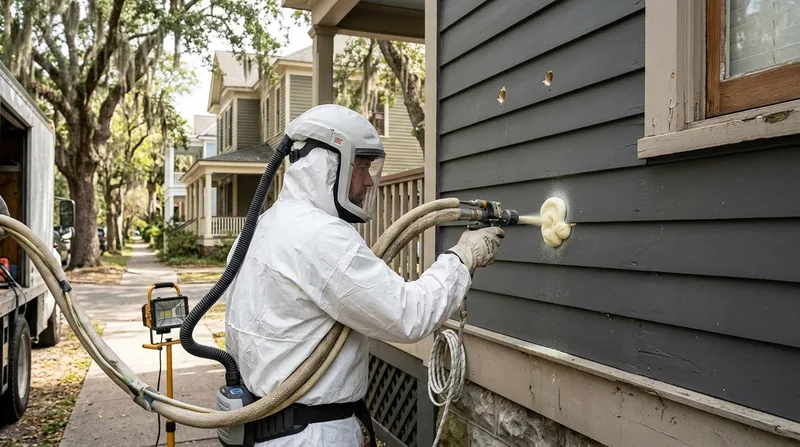




Wall & Injection Foam Insulation in Savannah fills the hidden cavities in your exterior walls without tearing into plaster or drywall, a critical upgrade for the century-old frame houses that line the Historic District, Ardsley Park, and Midtown. Savannah's hot, humid climate drives moisture inward through walls most of the year, and the Lowcountry's salt air and long cooling season put constant pressure on uninsulated cavities in older homes. Injection foam seals those stud bays from the inside, stopping air leaks and thermal loss without the cost and disruption of opening walls. Whether your home sits on a raised crawl space in the Historic District or in a newer subdivision pushing toward Pooler and Richmond Hill, wall injection foam works on the substrate you have. We help homeowners across Chatham, Bryan, and Effingham counties understand what their walls need and whether injection foam is the right answer for their home and budget.
Why Wall & Injection Foam Insulation Matters in Savannah's Older Homes
Savannah's architectural heritage is built on frame construction, and that means exterior walls that were never insulated or were filled with fiberglass that has settled, compressed, or failed over decades. The Lowcountry's moisture-driven climate means humid air penetrates through old plaster, brick veneer, and wood siding year-round. Uninsulated walls also mean rooms over unheated spaces run cold in winter, and exterior walls in summer heat absorb radiant energy that air conditioning has to fight all season long. Injection foam seals the cavities without demolition, restores R-value where it matters most, and stops the air leakage that fiberglass alone cannot address.
- Fills settled or missing fiberglass in stud cavities without opening walls or removing plaster.
- Seals air gaps that fiberglass leaves behind, stopping infiltration and exfiltration.
- Improves comfort in exterior rooms, especially those on the north side or over crawl spaces.
- Reduces cooling load during Savannah's long, humid summer season when energy bills spike.
- Works in homes where exterior access is limited or architectural details must be preserved.
Injection foam is the retrofit answer for homes where the walls matter but opening them is not an option.
Key info: A century-old frame house in the Historic District with uninsulated exterior walls and settled fiberglass loses conditioned air through leaks and poor R-value. Injection foam fills those cavities in a single day without removing plaster, restoring insulation value and air sealing in one step. For details on how we handle other wall insulation needs, see our closed cell spray foam insulation page.
For guidance on permitting and local building code compliance for wall insulation work, consult your local building department or the Chatham County Planning and Development Services office.
How We Inject Foam Into Savannah Walls: The Process
Wall injection foam starts with a site inspection to map the wall cavities, identify any moisture, settled insulation, or obstructions, and plan drilling locations. We drill small holes (typically 1 to 1.5 inches) into the exterior wall at intervals, inject closed cell or open cell foam into each cavity, and seal the holes when complete. The process is fast, clean, and leaves no structural damage. Most single-family homes in Savannah finish in one to two days depending on wall square footage and cavity complexity.
- We inspect the wall cavity layout and identify any moisture, debris, or obstructions before drilling.
- We drill small access holes at calculated intervals along the exterior wall, typically on the band or rim area or at the base.
- We inject foam into each cavity under controlled pressure, filling from the bottom up to ensure complete coverage.
- We seal each hole with a foam backer rod and caulk that matches your exterior finish.
- We verify foam density and fill with a final inspection and a written estimate of R-value and thickness.
The entire process is non-invasive and preserves your home's exterior appearance and interior finishes.
Example: A 1950s brick ranch in Midtown Savannah has exterior walls with 2x4 studs and settled fiberglass that no longer provides R-value. We drill holes at the band joist, inject closed cell foam into each cavity, and seal them. The homeowner gains R-15 to R-19 in walls that were previously R-5 or R-0, plus air sealing that stops infiltration. The job takes one day and costs a fraction of opening and re-framing the walls. Learn more about air sealing and its impact on energy.
Wall Injection Foam Methods and Approaches
| Approach | Description | Best for |
|---|---|---|
| Closed Cell Injection Foam | High-density foam (3.5 to 4.5 lbs/cu ft) injected into cavities, cures rigid, provides R-6 to R-7 per inch, vapor barrier and air seal in one. | Exterior walls in humid climates, walls with moisture risk, maximum R-value in tight spaces. |
| Open Cell Injection Foam | Lower-density foam (0.5 to 1.5 lbs/cu ft) injected into cavities, cures soft, provides R-3.5 to R-4 per inch, breathable, allows moisture vapor to move. | Interior walls, sound dampening, walls where vapor permeability is desired, budget-conscious retrofits. |
| Partial Fill (Top-Up) | Injection foam added to cavities that already contain settled or degraded fiberglass, topping up to fill voids and seal air gaps. | Mid-century homes with existing insulation, cost-effective upgrade, avoiding full re-insulation. |
| Full Cavity Fill | Complete injection foam fill of empty cavities or after removal of failed insulation, delivering target R-value and air sealing. | Uninsulated historic homes, walls with no prior insulation, maximum performance retrofit. |
Closed cell is the standard for exterior walls in Savannah because it controls moisture and delivers higher R-value; open cell works for interior walls and where breathability is a design goal.
Wall & Injection Foam Insulation Cost in Savannah: What to Expect
Wall injection foam insulation in Savannah typically starts at $2 per square foot of wall area treated, though the final cost depends on cavity accessibility, wall height, existing insulation condition, and foam type. A single-story exterior wall with easy access and closed cell injection foam runs lower; a two-story home with brick veneer or tight rim joist access costs more because drilling and injection take longer. The key factors that move the price are wall square footage, whether fiberglass or other material must be cleared first, and whether the work requires scaffolding or lift access.
Getting two to three written estimates is the smart move. Each estimate should specify the R-value you are paying for, the foam thickness per cavity, the type of foam (closed or open cell), and the total wall square footage. Avoid any estimate that does not include these details, as it signals the contractor has not done a real site survey. Visit our full pricing overview to understand how foam type, wall size, and access affect the cost in your area.
Most Savannah homeowners see injection foam as a cost-effective alternative to opening walls and re-framing, especially in homes where architectural or structural details must be preserved. The job is fast, the disruption is minimal, and the energy and comfort payoff is immediate.
Wall & Injection Foam Insulation Near Me: What to Look for When Hiring a Contractor in Savannah
When you are ready to hire a spray foam contractor for wall injection work, verify that they carry full insurance coverage and can provide a certificate on request. Ask for references from recent wall injection projects in your neighborhood or in similar-age homes. A good contractor will give you a written estimate with R-value, thickness, foam type, and wall square footage, and will explain what permits or inspections apply at your address. They will also walk you through the re-entry window (typically 24 to 48 hours) and what to expect during and after the cure period.
- Verify full insurance coverage and ask for a copy of the certificate before work begins.
- Request references from at least two recent wall injection projects in Savannah or nearby areas.
- Get a written estimate that specifies R-value per inch, total thickness, foam type, and wall square footage.
- Confirm what permits are required at your address by contacting your local building department before signing a contract.
- Ask about the cure timeline, re-entry window, and any odor or ventilation expectations during and after the job.
- Understand the workmanship warranty period and what it covers (typically one to three years on the installation).
A contractor who gives you straight answers on these points, avoids pressure tactics, and is reachable after the job is the one to hire. For a free, no-obligation estimate and to discuss your specific wall insulation needs, contact us at (912) 483-1976.
Wall & Injection Foam Insulation in Savannah: Pricing Guide
| Service | Price | Details |
|---|---|---|
| Closed Cell Injection Foam | Starting at $2.50/sq ft | High-density foam, R-6 to R-7 per inch, vapor barrier, exterior walls and moisture-critical areas |
| Open Cell Injection Foam | Starting at $1.50/sq ft | Lower-density foam, R-3.5 to R-4 per inch, breathable, interior walls and sound dampening applications |
| Partial Fill (Top-Up) | Starting at $2/sq ft | Adding foam to settled or degraded existing insulation, cost-effective upgrade without full cavity replacement |
| Full Cavity Fill | On estimate | Complete fill of empty cavities or post-removal insulation, requires site inspection to determine total square footage |
| Travel and mobilization | Included | No separate charge for service calls throughout Savannah and surrounding Chatham, Bryan, and Effingham counties |
| Free written estimate | No charge | Response within 24 hours, specifies R-value, thickness, foam type, and wall square footage, no obligation to book |
Indicative pricing, the exact cost depends on square footage, finish, and site access. Free personalized estimate within 24h at (912) 483-1976.


